

Annapurna Conservation Area is Nepal’s largest protected area and its most-visited trekking region, covering 7,629 sq. km across five districts — Manang, Mustang, Kaski, Myagdi, and Lamjung. Established in 1986 as the country’s first conservation area, it’s managed by the National Trust for Nature Conservation (NTNC) under the Annapurna Conservation Area Project (ACAP), which pioneered Nepal’s community-based conservation model.

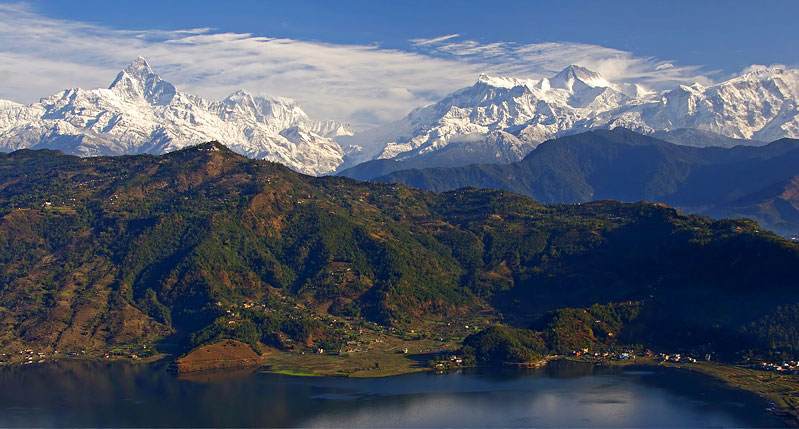
The area is anchored by Annapurna I (8,091 m), the world’s tenth-highest peak, and the striking double-summited Machapuchare (“Fishtail Mountain”), which remains legally closed to climbing out of respect for its sacred status to local communities.
Location & Geography
The conservation area spans a dramatic elevation range — from subtropical river valleys around 1,000 m to the summit of Annapurna I at 8,091 m — creating one of the most varied landscapes of any single protected area in the world. The gateway city is Pokhara, Nepal’s adventure-tourism hub, roughly 200 km (a 25-minute flight or 6–7 hour drive) from Kathmandu.
Permits & Entry Fees (2026)
Two permits are required to trek in the Annapurna Conservation Area:
| Permit | Foreign Nationals | SAARC Nationals | Notes |
|---|---|---|---|
| Annapurna Conservation Area Permit (ACAP) | NPR 3,000 (~USD 23) | NPR 1,000 | Free for children under 10. One permit covers every trail inside the conservation area for a single visit. |
| TIMS Card | Status varies by source for 2026 — some report it discontinued for standard Annapurna routes since 2023, others still cite NPR 2,000 (individual) / NPR 1,000 (group) | — | Confirm current requirement with your agency before departure |
Since April 2023, all foreign trekkers in the Annapurna Conservation Area must be accompanied by a licensed guide booked through a registered trekking agency — independent solo trekking is no longer permitted here. ACAP can be obtained online through NTNC’s e-permit portal, in person at NTNC counters in Kathmandu or Pokhara, or arranged by your trekking agency.
For the full step-by-step process, see our Annapurna Circuit Trekking Permits guide. Because permit rules have changed more in the last few years than in the two decades before, always confirm current requirements with NTNC/ACAP or your agency before booking.

Trekking Routes
Annapurna Circuit Trek — The classic route, circling the entire Annapurna massif over roughly two to three weeks. It crosses two river valleys and its highest point, Thorong La Pass (5,416 m), before descending into the dramatic Kali Gandaki Gorge. See our Annapurna Circuit packing list before you go.
Annapurna Base Camp (ABC) Trek — A shorter, roughly 7–12 day trek to the base of Annapurna I at 4,130 m, passing through Gurung and Magar villages including Ghandruk, with the Jhinu Danda hot springs as a popular stop along the way.
Ghorepani–Poon Hill Trek — A shorter 4–5 day trek best known for its sunrise viewpoint over the Annapurna and Dhaulagiri ranges — a good option for trekkers with limited time or less trekking experience.
Upper Mustang Trek — A restricted-area trek into the former Kingdom of Lo, a high-altitude desert landscape with centuries-old cave monasteries and the walled city of Lo Manthang — a completely different landscape from the rest of the conservation area, requiring a separate Restricted Area Permit.
Mardi Himal Trek — A shorter, less-crowded alternative offering close-up Machapuchare views away from the busier main trails.
Wildlife & Biodiversity
Annapurna Conservation Area protects over 1,200 recorded plant species, including extensive rhododendron forest that blooms across the mid-hills each spring, alongside rare orchids and medicinal herbs used by local communities for generations.
Notable wildlife:
| Category | Species |
|---|---|
| Mammal | Snow leopard (Panthera uncia) |
| Mammal | Red panda (Ailurus fulgens) |
| Mammal | Himalayan tahr, musk deer |
| Bird | Himalayan monal, over 450 recorded bird species region-wide |
The area’s elevation gradient — from subtropical forest to alpine meadow to high-desert terrain in Mustang — supports one of the widest ranges of habitat types found in any single protected area in Nepal.

Local Culture & Communities
The conservation area is home to Gurung, Thakali, Manangi, and other ethnic communities, each with distinct traditions, architecture, and cuisine. Villages along the main trekking routes preserve traditional stone housing with carved wood detailing, alongside monasteries reflecting the region’s Tibetan Buddhist heritage in its northern reaches. Local dal bhat and Thakali-style cuisine are trekking-route staples worth seeking out.
ACAP’s community-based model means permit revenue is reinvested directly into conservation and local infrastructure — trekking here has a more direct economic connection to the communities you pass through than in some other regions.
Best Time to Visit
Autumn (September–November) offers the clearest mountain views and most stable weather — the busiest season on popular routes. Spring (March–May) brings blooming rhododendron forest at lower elevations with slightly less reliable high-altitude visibility. Winter is possible on lower routes like Ghorepani–Poon Hill but high passes such as Thorong La can be snowbound. Monsoon (June–August) brings heavy rain and limited visibility — best avoided for most routes. See our full guide to the best time to visit Nepal for a season-by-season breakdown.

Where to Stay
Along the main routes, tea houses and lodges offer basic beds, hot showers, and meals — well-established infrastructure given how long this has been Nepal’s most popular trekking region. In larger villages and towns, more upscale lodges are also available for trekkers wanting extra comfort. For a more immersive stay, consider a homestay in Nepal in one of the trailside villages.
Safety Tips
- Acclimatize properly — altitude sickness risk is real above 3,000 m; ascend gradually and stay hydrated.
- Trek with a licensed guide — mandatory since April 2023, and genuinely useful for navigation and safety.
- Stay on designated trails to protect the environment and avoid getting lost.
- Pack for rapid weather changes — warm layers, rain gear, and a hat/gloves even in shoulder season.
- Carry water purification tablets and eat well to maintain energy on multi-day treks.
- Book through a registered agency — see our guide to choosing a trekking agency in Nepal if you haven’t already booked.
Conclusion
Annapurna Conservation Area remains Nepal’s most accessible introduction to genuine high-Himalaya trekking — a huge range of routes from the multi-week Circuit to the shorter, sunrise-focused Poon Hill trek, all within a region with well-developed infrastructure and deep cultural texture. Start by confirming current ACAP and guide requirements, choose the trek that matches your timeframe and fitness, and book through a registered agency well ahead of peak autumn season.
Discover more from Nepal Travel Vibes
Subscribe to get the latest posts sent to your email.


